
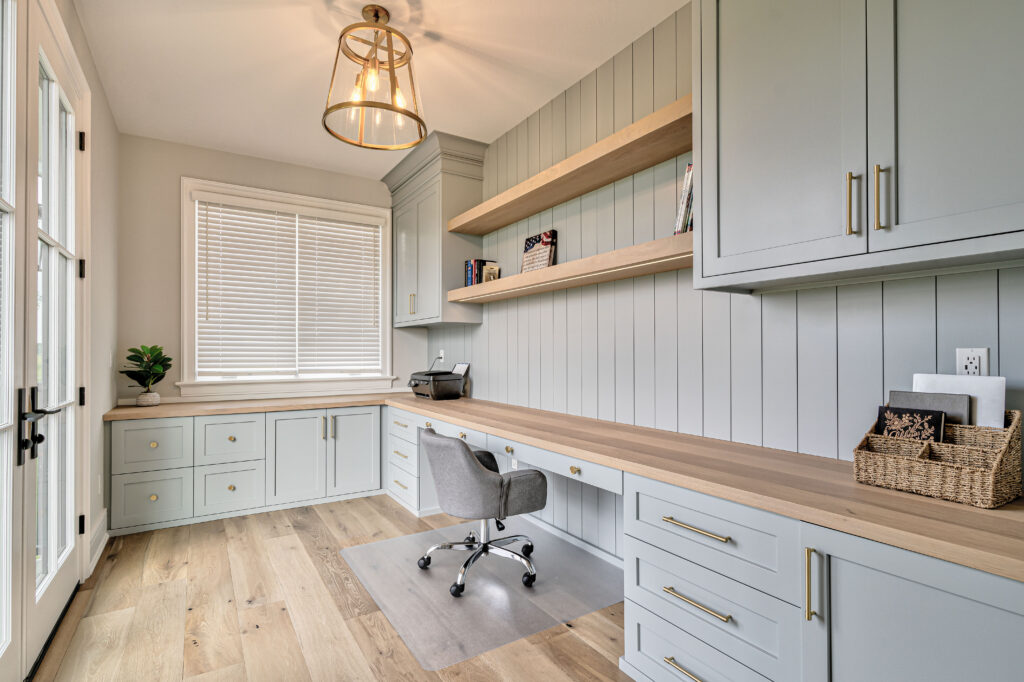
Every surface in a West Michigan custom home starts as a decision, and in a home built to this standard, those decisions pile up fast.
Most clients don't come in asking about substrate materials for their home. They come in with a vision: the kitchen they've always wanted, the library wall, the primary suite that feels like somewhere they look forward to ending the day. The material conversation lives underneath all of that, and it's one our team has already been having on your behalf long before you sit down with our designers.
Since 1999, with over 330 homes, the question of when to use wood, melamine, or MDF isn't something we figure out on a project-by-project basis. It's something we've refined through enough kitchens, closets, and stairways to know which material belongs where, and why getting that wrong costs more than it saves.
Wood: When The Material Itself Is Part of The Design
Wood shows up in Engelsma homes where it will be seen and felt for the lifetime of the house. Not as a finish you install and forget, but as a material still part of the room twenty years from now.
Where we use it:
• Handrails and interior trusses
• Beams and structural detail
• Kitchen islands and range hoods
• Half-bath vanities
• Key cabinetry pieces with daily client contact
• Exterior architectural details
Grain variation, warmth, stain that settles differently across every piece. That's the beauty of wood, and exactly why we use it. It's also where our team puts in work on material selection, grain matching, and finishing decisions that most clients never see.
White Oak: Popular, Demanding, and Worth Getting Right
White oak is one of the most requested finishes right now, and one of the more demanding to execute well. The challenge isn't craftsmanship, it's chemistry.
The core issue: Heartwood and sapwood take stain differently. A clear or near-clear finish, exactly what most clients requesting white oak want, leaves almost no room to blend pieces toward consistency. There's no color to work with. What you see is the wood, exactly as it came.
What we do behind the scenes:
• Hand-sort all material before it reaches the shop
• Pre-plan for a higher scrap factor when selective culling is required
• Apply careful grain matching across panels, a step most builders skip
• Arrange engineered wood panels so grain reads as natural, not mechanical (the alternative is the familiar repeating dot or figure pattern visible across every cabinet face)
We educate every client on this before we get there, not after. The inspiration shots on Pinterest and Houzz are from $8–9M homes, photographed at the right angle, in the right light, after careful curation. What you're seeing is a result, not a guarantee. Our job is to close that gap, so the client gets what they anticipated.
Longevity: Wood's Durable Advantage
At this price point, wood has a longevity advantage that matters: it can be sanded, restained, and refinished. The same damage on a melamine surface is permanent. For clients thinking in terms of decades rather than years, that distinction defines which applications call for solid wood and which ones don't.
The Tradeoff: Where Wood Works and Where It Doesn't
Solid wood moves. It expands and contracts with humidity — which means:
• Door frames need to account for seasonal shifts
• Large flat panels in wood can introduce warping risk if not engineered correctly
Our cabinet designers spec wood where it performs best, and step back from it where it doesn't.
Melamine: The Starting Point For Closets, and The Right Call For a Lot More
Melamine is our starting point for closet systems, and it earns that position for practical reasons that clients tend to appreciate once they understand them.
It's a prefinished product that installs cleanly, delivers a consistent finish across every surface, and handles daily wear without the upkeep a wood interior would require.
The design range has expanded considerably in recent years. When we use melamine as an accent or complement to natural wood, we have a strong selection of tones that pair well with whatever the primary material is in the space.
The limitation is that melamine can't be routed into profiles the way wood or MDF can, and damaged edges don't repair cleanly. Placement determines whether it's the right call.
MDF: The Foundation For Flawless Painted Finishes
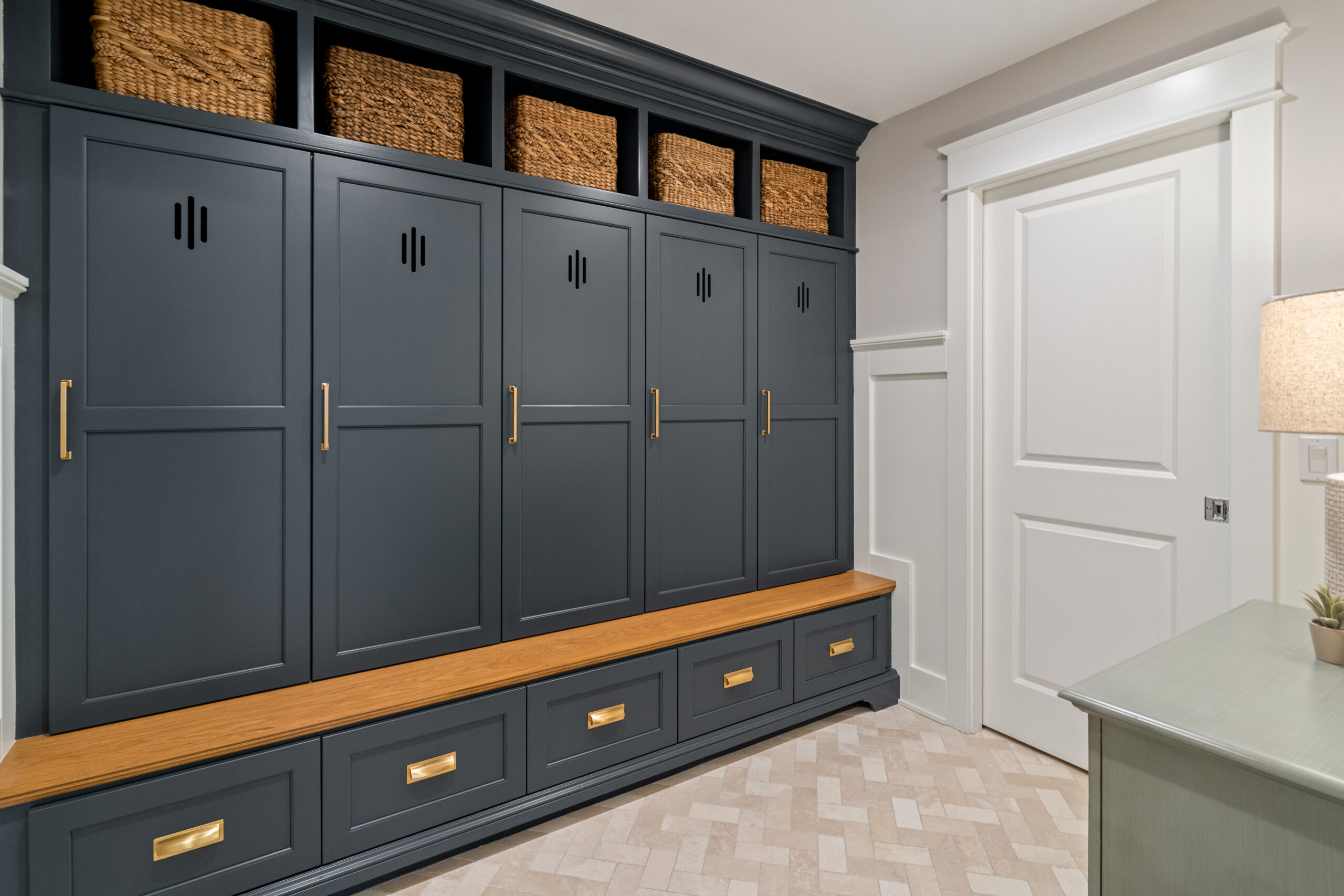
Medium-density fiberboard (MDF) is what our team reaches for when the goal is a painted finish with no grain, no movement, and no variation. It's uniform throughout, machines cleanly, and takes paint in a way that solid wood often can't match.
Painted cabinetry is the primary application. If you've seen a painted shaker cabinet with knife-sharp edges and a finish that reads more like furniture than millwork, MDF is almost certainly what made that possible. It's also the substrate for applied moldings and detailed millwork where wood grain would work against the design.
MDF is heavier than other engineered materials and more vulnerable to water damage at the edges if they're not properly sealed, so it belongs in interior applications where it won't see sustained moisture exposure.
Stair Treads: One Place Where Material Choice is Easy to Get Wrong
Most flooring manufacturers sell nosings and stair treads made from the same engineered hardwood as the flooring itself. It's convenient, it matches, and it usually looks fine at installation.
However, engineered hardwood has a thin veneer layer, and stairs take more concentrated, repetitive traffic than any floor surface in the house. That veneer wears. Our shop makes stair treads from solid material, which handles that kind of concentrated traffic in a way a veneered product simply doesn't. It's a detail most clients never think to ask about, and one that shows up in how the home performs a decade in.
How These Materials Work Together in a Single Project
All three materials are usually present, often in the same room, doing different jobs.
A kitchen might have MDF painted door fronts with crisp profiles, melamine interiors in the cabinet boxes and drawers for durability and ease of cleaning, and a solid wood or veneer island base because that's the piece you'll be standing at, touching daily, and looking at from every angle in the room. The result looks unified because our design and cabinet teams are specifying them in relation to each other, not independently.
This is part of what the cabinet design process at Engelsma delivers: not just drawings, but the reasoning behind every material call, coordinated across every surface in every space. Most clients never want to know what their drawer boxes are made of; they just want the kitchen to work exactly the way they imagined it, and have it still look that way fifteen years later.
The Engelsma Homes Approach to Material Selections
Our designers come in with a direction informed by how you've described using the space, what the design calls for, and what the specific application demands over time. You're not being asked to choose between MDF and melamine on a spec sheet. You're being asked whether you want the island base to feel more like furniture or more like cabinetry, and we handle the rest.
Decision fatigue is a genuine concern, and for clients who are making consequential decisions every day at work, the last thing a home build should add to the list is a materials science quiz. Our job is to know this well enough that you don't have to.
Curious about how our design and cabinet teams approach your project? Our process starts before you pick a single finish. Contact Engelsma Homes, Michigan home builder, to begin the conversation.